By Robert H. Pickett Sr., PAT Labs
If you’ve read many antenna papers, you know the feeling. One design says 18 dBic, another 15.2 dBi, a third 14.5 dB, and they all sound like winners. They usually aren’t measuring the same thing. I wanted to sort that out for one antenna family I care about, so I went to the actual papers. Today I’m putting that work out as an open preprint on Zenodo: the Vivaldi Antenna Evidence Map, version 0.3.0.

Why Vivaldi antennas
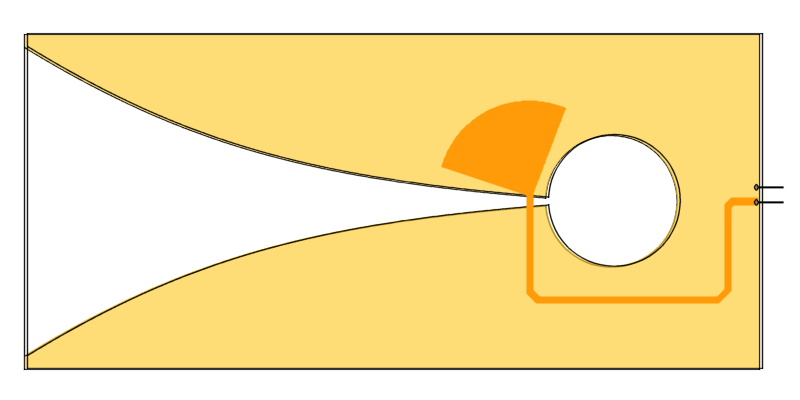
A Vivaldi antenna is an exponentially tapered slot: a traveling wave rides along the slot and radiates off the end as the slot opens up. P. J. Gibson described the “Vivaldi aerial” in 1979. With no single resonant length, it covers a very wide band, which is why Vivaldis show up in see-through-wall imaging, remote sensing, breath-detection radar, and radio-astronomy phased-array feeds. People modify it with corrugations, slots, paired radiators, arrays, directors, lenses, metamaterial loading, and shrinking tricks. The hard part is telling which of those changes actually earns its keep.
What an evidence map is (and isn’t)
An evidence map lays out what a set of studies reports, side by side, and is honest about where they can’t be compared. It is not a meta-analysis. I pooled no numbers and kept every value in the authors’ own units: gain, realized gain, directivity, dB, dBi, or dBic. Nor is it a full survey of the field: no database search was run, and the inventory came from my own study notes.
Here’s the scope, the way the paper defines it:
- 20 records in a frozen working inventory, dated 2008 to 2026.
- 17 of those are citable, with solid publisher metadata.
- 3 are excluded because I couldn’t recover an authoritative DOI or PDF.
- 2 citable reviews are kept as context only and don’t add to the counts.
- That leaves 15 mapped records: 13 primary antenna designs and 2 system demonstrations.
What the evidence says, by design feature
The biggest takeaway: from Gibson’s 1979 aerial to the newest designs in the set, the exponential slot itself hasn’t changed. It’s still the engine. What later work does is make three kinds of moves around it, and those moves are what “works better.”
1. Relocate the current to get a lower usable frequency in the same width. Corrugations, edge slots, cavities, and slow-wave slots lengthen the current path without growing the copper. Only R03 tests this on one element with several geometries: going from no corrugation to rectangular slots to conformal slots, the cutoff drops from 5.1 GHz to 4.5 GHz to 3.2 GHz on a 50 × 125 mm Teflon board. At the same edge width, conformal slots are longer. Others push compactness: R12 trades some radiation efficiency for low-end match with slow-wave slots and resistors, at about 70% less area.
2. Add aperture in front of the slot for more gain and a cleaner beam. The higher directional gain numbers come from more structure in the end-fire direction, not from a better taper. A second slot fed in phase (R02) flattens the wavefront and stops high-frequency beam split, reporting 14.5 dB at 10 GHz against a same-size conventional Vivaldi. Lenses, directors, and reflectors push further. R05 reaches up to 18.35 dBic with four elements and a lens, and R17 reports 14.5 dBi with a 17.1 dB front-to-back ratio using a hexagonal reflector. Real numbers, but from bigger structures, not the same footprint.
3. Change the feed and the number of slots. Antipodal and stripline Vivaldis mainly make it easier to connect to 50 Ω. Almost every high-gain number in the set is more than one radiator plus a feed network. R16, for example, is a 220-radiator phased-array feed with only 24 single-polarization channels digitally beamformed. Coherent addition explains those results, not a single-element “Vivaldi modification.”
Bottom line: tables that mix dB, dBi, and dBic, one frequency with a whole band, and a small element with a large array make designs look like they compete on the same number. They don’t. So the paper ends with a short reporting checklist: name the quantity and units, the matching threshold, whether the band is continuous, electrical size at the low edge, the comparison geometry, and how it was validated.
What changed in v0.3.0, and why I’m telling you
Version 0.2.0 was built from my secondary notes. For 0.3.0 I went back and re-extracted every citable record from the publisher’s own PDF, and some of my earlier statements didn’t survive. The clearest one is R03: my earlier note credited it with a gain above 8 dBi across the band, but the R03 paper itself never says that. That claim is withdrawn. R03’s real contribution is the lower cutoff and better low-band pattern, which is still the only same-element evidence in the set. I also found that R01 is two separate arrays, not one, and that R19’s simulated and measured bands shouldn’t be merged.
I’d rather publish a correction than defend a number I can’t back up. The limitations are in the paper too: a convenience sample, one reader, three records still unmapped.
This is part of a bigger body of work we’ve been doing. For example, there’s our study of the three-body problem, which you can find here: Finite-Time Forbidden-Region Discovery in Three-Body Dynamics.
Read it, use it, check it
Pickett Sr., Robert H. (2026). “Vivaldi and Antipodal Vivaldi Modifications: An Evidence Map of a 20-Record Working Inventory (2008–2026),” version 0.3.0. Zenodo preprint, CC BY 4.0. https://doi.org/10.5281/zenodo.23785903
The release includes the paper as a PDF and a Word file, plus the full data package: the study inventory (CSV), figures, and BibTeX references. It’s open access. Use it, build on it, and if you find something I got wrong, tell me.
PAT Labs (Pickett Applied Technologies Laboratories LLC) is a service-disabled veteran-owned small business in Albany, Oregon. We do applied RF and electronics research, and we try to build things that give something back.