Long-range point prediction in chaotic systems is fragile. A weaker but often more stable question asks whether a body or configuration can enter a specified region during a finite interval. That question is set-valued: it concerns every initial state in a prescribed family and every time in a horizon. Invariants can sometimes answer it exactly even when individual trajectories are sensitive to initial conditions.
Put simply, instead of trying to predict exactly where three bodies will be, we asked whether conserved quantities and finite-time dynamics could tell us where they definitely cannot be.
This manuscript tests that idea on the classical three-body problem.
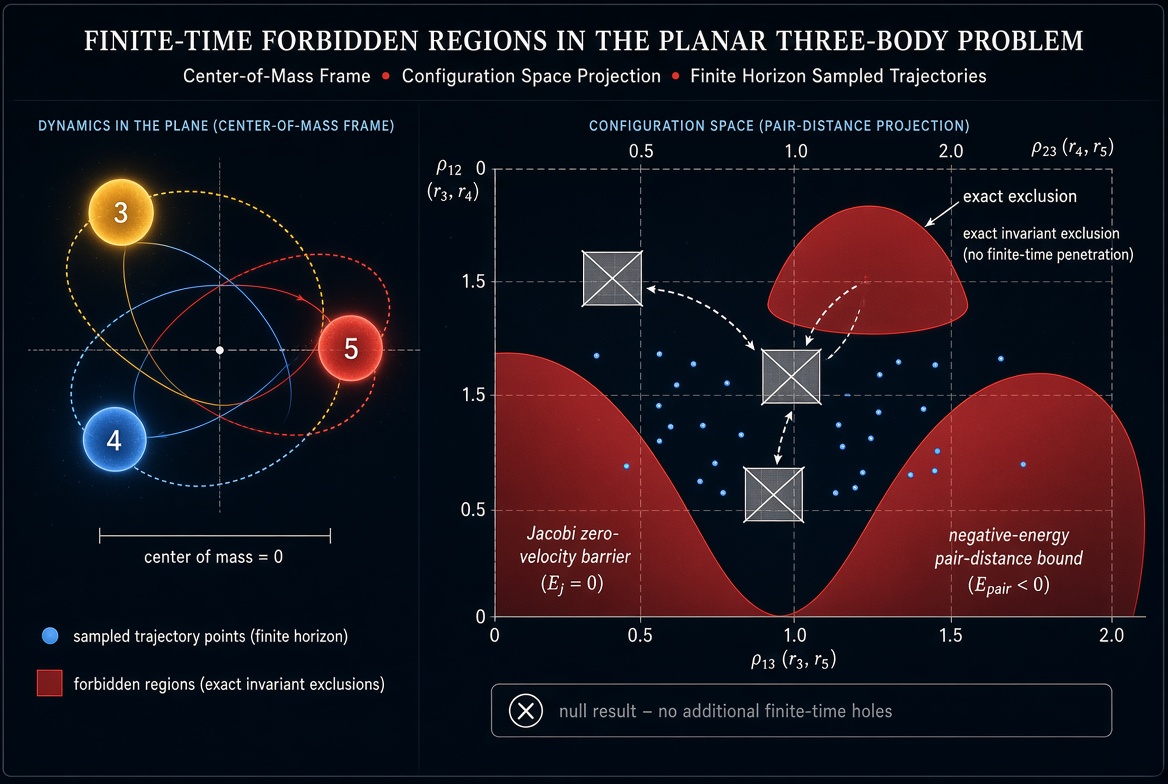
We recovered two exact invariant exclusions as analytic controls. In the Earth–Moon circular restricted three-body problem at fixed Jacobi constant, any point where the effective potential yields a negative squared speed is unreachable by a real velocity. On the unrestricted planar energy surface corresponding to the classical Burrau (3-4-5 Pythagorean) problem with zero angular momentum, at least one pair of bodies must always satisfy a hard upper bound on separation of approximately 3.667. Both statements follow directly from the conserved quantities and require no trajectory sampling.
Does this solve the three-body problem? No. It does not provide a universal formula for predicting three gravitating bodies indefinitely. It investigates a narrower question: whether specified regions can be ruled out over a finite horizon without predicting the exact trajectory.
We then asked whether a broad fixed-invariant family in the unrestricted planar problem produces any additional finite-time exclusions over a horizon of three characteristic cycles. Positions and velocities were sampled on the invariant manifold (masses 3, 4 and 5; fixed Newtonian energy equal to the classical Burrau value; zero center-of-mass, total momentum and angular momentum; moment of inertia between 15 and 120; minimum initial separation 0.2). Adaptive classical RK4 propagated 450 000 attempted states; 323 466 complete trajectories passed a strict energy-drift gate. Physical-space and full three-pair-distance occupancy were recorded across more than 6.7 billion reported integration steps when the restricted-problem control campaigns are included.
Unvisited voxels whose centers passed elementary feasibility filters (triangle inequalities plus the kinetic-energy lower bound implied by angular momentum) were treated only as discovery candidates. They were ranked by interior depth after binary erosion, then attacked with differential evolution that stayed algebraically on the same invariant manifold. Every selected survivor—including the deepest expanded-domain targets—was reached by a high-accuracy, independently re-integrated numerical trajectory. High-order DOP853 re-integrations at successively tighter maximum steps confirmed entry into the inset interiors with pair-distance spreads orders of magnitude smaller than the safety margins.
No candidate survived adversarial falsification. Interval certification was therefore never initiated, and no new theorem is claimed. The primary outcome is a null result for additional numerical finite-time exclusions in the tested family and horizon.
That null is informative. Sparse occupancy maps can visually suggest forbidden structure that disappears under directed search. The asymmetric evidentiary rule used here—one verified hit destroys a candidate, while any number of optimizer misses fails to prove exclusion—prevents the common error of treating empty cells as proof. Exact Jacobi and negative-energy barriers remain valid. The campaign simply shows that, for this broad fixed-invariant ensemble and finite horizon, no further robust holes survived the discovery–falsification chain.
Conceptually the method reasons from negative space: remove what is certified impossible, and the remainder is an outer envelope of where the system may be. That remainder is possibility, not a probability distribution, and “not proved forbidden” is not the same as “proved reachable.” Finite-time forbidden-region statements are therefore a meaningful alternative to indefinite point prediction, provided the evidence is typed correctly—invariant proof, numerical candidate, adversarial survival, or validated certificate.
The full blinded manuscript (methods, claim taxonomy, all attack seeds, strict step-convergence data, limitations, code and data availability statements) is available on request. Reply or direct-message “PDF” and I will email a copy.
The correct publishable outcome is the null result itself.
Research-assistance disclosure: The mathematical synthesis, computational workflow, software development, numerical analysis, and manuscript drafting were performed with substantial assistance from Arena.ai Agent Mode under the author’s direction. The author executed and supervised the study and accepts responsibility for the published claims.
Leave a Reply